Showing posts with label and the study of George Rosen in Manhattan. Show all posts

Wednesday, November 2, 2011

Telephone Wires Above Ground, Telephone Wires Below Ground


Manhattan, NYC, Broadway, 109th Street looking north
Tenafly, New Jersey, looking east, November 1, 2011

storms, wind storms, hurricanes, lightning, and almost all meteorological phenomena almost invariably cause power failures in the suburbs. no heat and no light for days (still counting in Bergen County since the 31 October, 2011 storm. yet the power companies, the utilities, rake in huge profits. too costly they argue to place the lines underground. but we are living in the 21st century, yet our streets in the suburbs and in rural areas resemble the nineteenth century. why are so many European countries, for instance The Netherlands, Belgium, France, England, to name only a few, free of these anachronisms? why should customers pay the incredibly high rates charged for power services when the grids always fail, the lines collapse, the posts keel over. it is time for a change and that change should be now.

Wednesday, April 6, 2011

The East Side Drive: New York City, Manhattan: north of 96th street


recording the past before it vanishes, and its memory is erased. the blur suggests what will happen in the not too distant future

Wednesday, August 4, 2010

George Rosen: in memorian, died 27 July 1977


My father George Rosen, MD, Ph.D., died 33 years ago in Oxford , England. It is in memory of my beloved parent that I wish to memorialize him, once again. Remarkable by any measure, the man, the author, the practitioner, the teacher, he exerted a deep and lasting influence on his generation and on the generation that was to follow his. As a parent he was loving and exacting, and gave both my brother, Paul Peter Rosen, M.D.,and myself a lasting love for the world, be it cultural experience, anthropological understanding, scientific curiosity and practice or innumerable other facets of knowledge: nothing seemed too small or too large to consider. How fortunate I was to be nurtured in this context. Books surrounded us and music from Dowland to Brecht with the MJQ and the Blues were staple fare. Lucky me. I vividly recall Balanchine's troupe at the City Center and Jose Limon at Barnard. My father's great love, his wife, my mother, Beate Caspari-Rosen shaped the welcoming atmosphere of the household. But it was a household that focused on work. In the evenings, after my parents returned from their busy day of teaching or practicing medecin:, my father wrote and my mother assisted him in his labors. We did not have a television set until the 1960s! But among my very earliest memories are visits to museums, and hikes in New York City and later in New York State and Maine.
Thirty-three years ," three decades and then some," and yet my father's presence is as vivid as ever. It is only his voice that I have difficulty recreating. But somewhere an archive must hold a recording of his voice .

My father was born in Brooklyn, New York and his parents may have been born in the Ukraine in Lvov. But I am uncertain. Since I inherited my father's curiosity and I am an historian, I hope to be able to piece together fragements and regain the past that vanishes into obscurity.
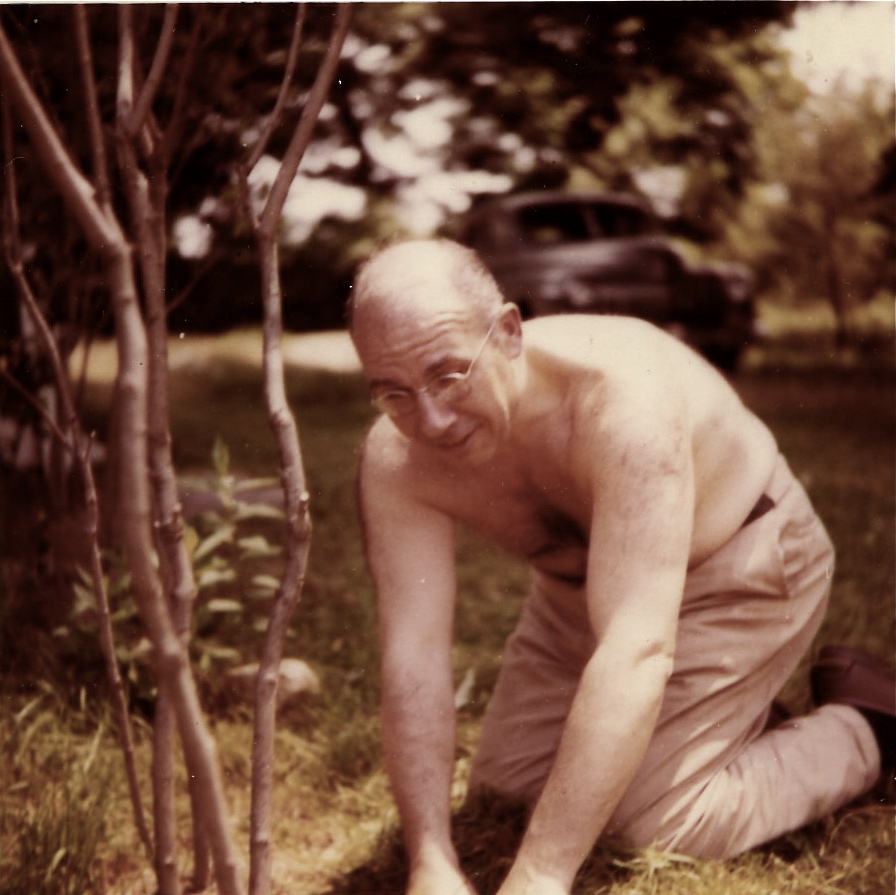
The photographs I have chosen do not follow an argument or a chronology, but they do show facets of his life: he gardened, he served in the military, voluntarily enlisting. Knowing at first hand the Nazi agenda, since he received his medical degree in Berlin during the rise of Hitler in the 1930s, he did not hesitate, despite the fact that he had two babies and a wife and family who depended upon him. Among his other duties was intelligence, medical intelligence to discover what was taking place in the concentration camps. Fluent in German and a physician, he interviewed German military charged with carrying out extermination and more.

Two pictures relate to that phase of his life. His teaching career began at Columbia University, The School of Public Health, now titled The Mailman School of Public Health (And to keep this post up to date, the institution where Chelsea Clinton received her doctoral degree.). In the 1960s , he went to Yale University, where he had a joint appointment , teaching the history of medicine and also courses Public Health.

People with his commitment to public health and who fought for it despite grave consequences are difficult to locate today. And his vast knowledge was brought to bare on the history of medicine. His work opened up mnumerous avenue for research and to this day his work still lives, I am thankful to report.
And now for the pictures:
Military Intelligence
Service form
Canterbury Ct, North Society Road, my parents. Schatzi our dachshund, myself and a friend
George Rosen tending the lilacs in Canterbury
Geroge Rosen seated at his desk, in his office at Columbia School of Public. Note objects on desk


Wednesday, June 23, 2010

George Rosen, M.D., Ph.D: Centenary celebration


100 years ago my father was born. He had barely crossed over from his 66th year, turning 67 a mere two months before his death. In his brief lifetime he accomplished much. He was a man of distinction, a man of imagination, a man who believed that the world could be a better place. He looked back into the past, lived in the present, and tried as best as he could to make the future a better healthier world through his energetic actions in public health, his publications in that field, and, also through his historical studies. The latter taught what had been and the trends that ensued from occurrences, decisions, politics, and mentalities that shaped the world of his fathers and his own world, as well. This brief encomium, written by a loving daughter who has now survived her father by more than a year, is a pale reflection of both the man and his work. May he never be forgotten for who he was and what he performed for his family and the world that he engaged bravely, and did not lose heart despite bearing witness to the catastrophes of the twentieth century. Too bad a dialogue with the dead is a one-sided affair. How grateful I would be to engage him in conversation and to learn from him still.
Curiosity was limitless, a quality reserved for the minds of the great.